
Last updated: April 18, 2026
Key Takeaways
- AS9100 requires layered PCB testing that includes AOI/AXI, flying probe ICT, functional testing, and Environmental Stress Screening (ESS) to support near zero-failure reliability.
- Core aerospace standards include IPC-A-610 Class 3 workmanship, full material traceability, and First Article Inspection (FAI) aligned with AS9102 guidelines.
- Aerospace testing goes beyond commercial practice through 100% inspection coverage, serialized tracking, and risk-based sampling plans.
- The upcoming IA9100 transition in Q4 2026 will strengthen product safety and information security requirements while preserving core AS9100 principles.
- Pro-Active Engineering provides AS9100-certified, ITAR-compliant PCB assembly with integrated testing; get a DFM review and rapid prototype quote to start your aerospace project.
AS9100 PCB Testing: Executive Summary & Core Requirements
AS9100 aerospace PCB assembly testing follows a layered approach that builds from visual checks to full system validation. Each layer catches different defect types and reduces the chance of field failures.
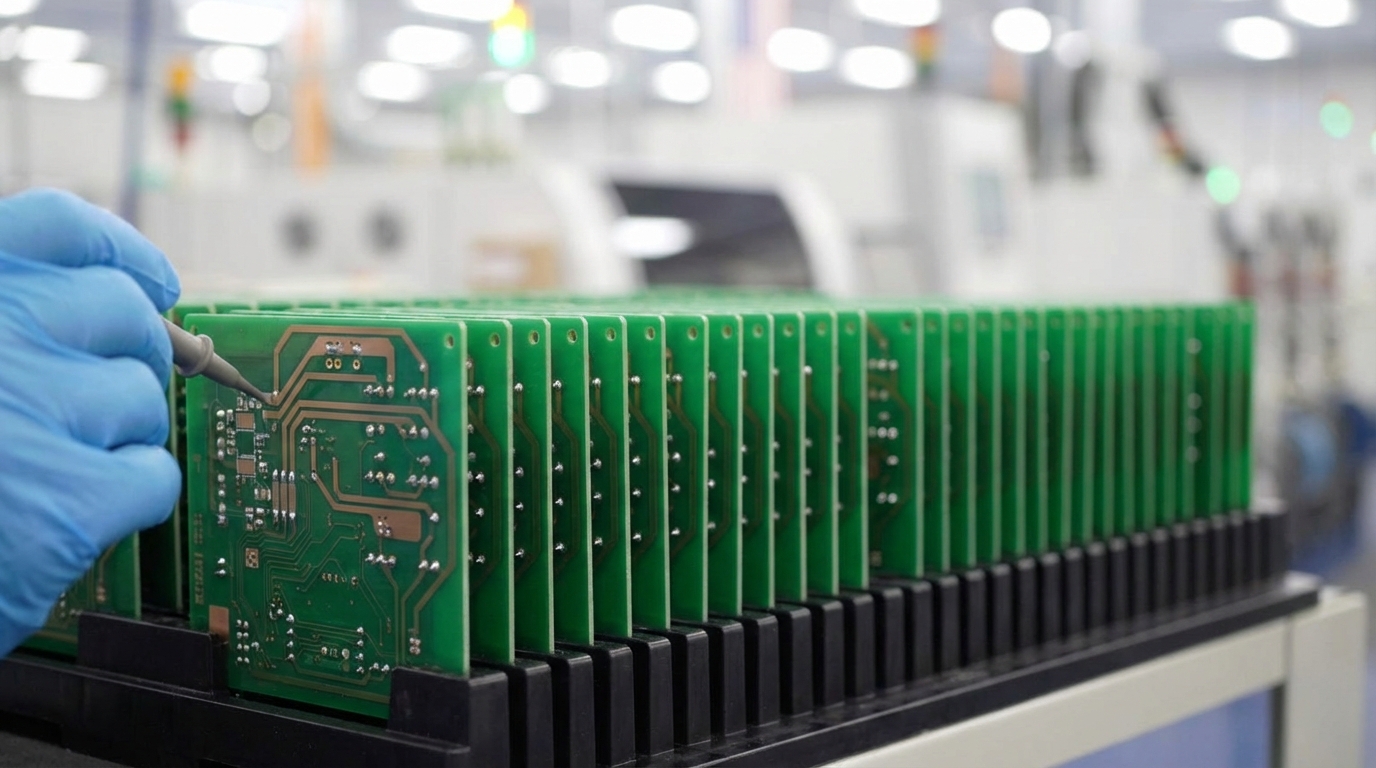
1. Visual Inspections via AOI/AXI: Assembled PCBAs can undergo Automated Optical Inspection (AOI) and X-Ray Inspection to verify solder joint quality, particularly for invisible joints like BGA components. These inspections create the baseline by confirming placement accuracy and joint integrity.
2. Flying Probe/ICT Electrical Testing: Advanced testing platforms include flying probe, boundary scan, in-circuit testing, and functional testing with serialized traceability. This electrical layer validates continuity, isolation, and component values after visual issues are cleared.
3. Functional Circuit Testing (FCT): Functional Testing simulates real-world operation to confirm assembled boards perform according to intended functions, measuring voltage, current, and signal behavior. These tests confirm that electrically sound assemblies behave correctly in application-like conditions.
4. Environmental Stress Screening (ESS): Thermal cycling and random vibration screening in accordance with industry specifications can help eliminate latent defects such as cold solder joints. ESS exposes assemblies to controlled stress so hidden weaknesses appear before deployment.
5. IPC-A-610 Class 3 Workmanship: Aerospace programs often apply IPC Class 3 PCB assembly standards. Class 3 criteria tighten allowable defects and require more rigorous inspection.
6. Material/Process Traceability: AS9100 requires suitable means to identify process outputs and provide traceability when applicable, which may include serial numbers, batches, or lot traceability for components and assemblies. This traceability connects every assembly back to its materials and process history.
7. Risk-Based Sampling: AS9100 does not require 100% inspection for critical characteristics, which may instead be customer-mandated or replaced by approved sampling or statistical process control plans. Programs often combine 100% checks on critical features with data-driven sampling elsewhere.
8. First Article Inspection (FAI): AS9100 requires First Article Inspection (FAI) as a production process verification activity, with AS9102 referenced for guidance on performance but not required. FAI confirms that the defined process can repeatedly produce conforming hardware.
Pro-Active Engineering delivers AOI and flying probe testing as standard across all aerospace programs, supported by our AS9100 and ITAR certifications. These capabilities anchor the broader test strategy described above.
AOI and X-ray Inspection for AS9100 Assemblies
Automated Optical Inspection uses high-resolution cameras and pattern-recognition software to compare every solder joint and component against the digital reference design, identifying polarity errors, insufficient solder, and lifted leads. X-ray Inspection penetrates components and solder joints, evaluating hidden connections in BGAs, QFNs, and LGAs for voiding, bridging, or insufficient solder volume.
Detection criteria include solder defects, BGA void analysis, and verification of critical joints. Pro-Active Engineering applies documented inspection protocols that ensure consistent coverage across all aerospace assemblies.
Flying Probe ICT for Aerospace PCB Validation
Flying Probe Testing uses movable probes to perform electrical checks on pads, vias, and test points without custom fixtures, suitable for prototypes and low-volume production. Testing verifies opens, shorts, and component values through comprehensive electrical validation.
Pro-Active Engineering’s flying probe capabilities support rapid 2-5 day prototyping through our Speed Shop while maintaining full production-level testing protocols.
Environmental Stress Screening for Aerospace PCBs
Environmental Stress Screening includes thermal cycling and random vibration screening in accordance with GEVS-SE or customized client specifications. ESS protocols precipitate latent defects through controlled stress application and reveal potential failure modes before field deployment.
Pro-Active Engineering conducts ESS testing to help ensure assemblies withstand expected operational environments.
PCB Functional Testing in Aerospace Programs
Functional and System-Level Testing validates comprehensive performance metrics based on client test plans. System-level validation confirms end-to-end functionality under operational conditions.
Pro-Active Engineering develops custom functional test workflows that align with our engineering-driven manufacturing process. This alignment reduces handoffs and keeps validation consistent from prototype through production.
Aerospace PCB Assembly Workflow: AS9100 Checklist
AS9100 compliant aerospace PCB assembly follows a structured workflow that ties design decisions to final documentation. Each step builds traceability and reliability into the product.
1. DFM Review: Engineering analysis for manufacturability optimization
2. Incoming Inspection: Component verification and authentication
3. Kitting Controls: Serialized material tracking
4. Assembly Processing: High reliability workmanship standards
5. AOI/AXI: Optical and X-ray inspection
6. Electrical Testing: Flying probe and in-circuit validation
7. Functional Testing: System-level performance verification
8. Environmental Stress Screening: Latent defect precipitation
9. Final Inspection: Comprehensive quality verification
10. Documentation Package: Traceability records
Pro-Active Engineering’s integrated workflow minimizes handoffs between design, prototyping, and production phases. Start a supplier audit to benchmark your current partner against these AS9100 requirements.
AS9100 vs Commercial PCB Testing
The gap between commercial and aerospace testing becomes clear when comparing specific requirements side by side. AS9100 programs demand full inspection coverage and traceability where commercial builds often accept sampling and basic lot tracking.
| Requirement | Commercial Practice | AS9100 Mandate | Pro-Active Capability |
|---|---|---|---|
| Inspection Coverage | Sampling AOI | Comprehensive AOI/AXI | With documentation |
| Cost Premium | Standard pricing | Varies | Integrated value pricing |
| Traceability | Basic lot tracking | Suitable means to identify process outputs and their status with respect to monitoring and measurement requirements, when applicable | Complete digital traceability |
| Workmanship Standard | IPC Class 2 | IPC Class 3 often applied | Class 3 certified processes |
Upgrading from IPC Class 2 to Class 3 can increase costs and lead times due to stricter process controls. These cost increases stem directly from Class 3’s zero-defect tolerance, which removes sampling-based inspection and requires far higher coverage.
AS9100 Traceability Requirements
AS9100D does not specify mandatory retention periods for records; organizations must determine retention periods based on customer requirements, regulatory obligations, and risk assessments. These decisions shape how long traceability data remains available for audits and investigations.
AS9100 requires suitable means to identify process outputs and provide traceability when applicable, which may include serial numbers, batches, or lot traceability for components and assemblies. This traceability foundation supports counterfeit prevention by linking each assembly to its material and process history so suspect parts can be isolated.
Counterfeit parts prevention therefore relies on both robust screening and effective quarantining of suspect components. Pro-Active Engineering maintains comprehensive traceability, ITAR compliance, and SiliconExpert integration for component lifecycle management.
IPC-A-610 Class 3 Aerospace: Risks, Pitfalls & Supplier Vetting
Critical risks include insufficient ESS that allows latent defects to escape and counterfeit component infiltration requiring dedicated prevention processes. Mitigating these risks starts with rigorous supplier vetting that verifies AS9100 certification, Class 3 capability, and domestic manufacturing capacity.
Pro-Active Engineering’s domestic Wisconsin facility addresses these concerns by eliminating long, fragile supply chains and reducing counterfeit exposure. Our team also provides rapid 2-5 day Speed Shop prototyping. Get a supplier evaluation to de-risk your aerospace program.
Frequently Asked Questions
What is AOI under AS9100?
Automated Optical Inspection requires every solder joint and component placement to be verified against digital reference standards post-reflow. Unlike commercial sampling approaches, complete coverage supports high reliability. This includes verification of component polarity, solder fillet formation, and placement accuracy across the entire assembly. Pro-Active Engineering implements AOI as standard practice across all aerospace programs.
How does ESS differ for aerospace PCBs?
Environmental Stress Screening for aerospace applications precipitates latent defects through controlled thermal cycling and vibration exposure per industry standards such as DO-160. ESS protocols exceed commercial burn-in testing by applying stresses that reveal potential failure modes before field deployment. The process can include temperature extremes, humidity exposure, and mechanical stress to support reliability in mission-critical environments.
What distinguishes IPC Class 3 from Class 2?
IPC Class 3 imposes stricter tolerances, defect criteria, and inspection coverage compared to Class 2’s sampling-based approach. Class 3 requires tighter component placement tolerances, more stringent solder joint criteria, and comprehensive documentation including operator records and machine settings. The cost premium often reflects lower yield rates and increased inspection overhead.
What is flying probe ICT for aerospace PCBs?
Flying probe In-Circuit Testing uses movable probes to perform fixtureless electrical verification on aerospace assemblies. This method enables rapid prototyping and low-volume production testing without custom fixtures, which suits complex aerospace programs with frequent design changes. Pro-Active Engineering’s flying probe capabilities support 2-5 day prototype delivery while maintaining production-level test coverage.
What are AS9100 traceability requirements?
AS9100 requires suitable means to identify process outputs and provide traceability when applicable, which may include material certifications, heat/lot numbers, and First Article Inspection documentation. AS9100D does not specify mandatory retention periods for records; organizations must determine retention periods based on customer requirements, regulatory obligations, and risk assessments. Together these controls enable accountability from raw materials through field deployment.
What are the key IA9100 2026 updates?
The IA9100 standard is anticipated to introduce enhanced requirements for information security, product safety, and quality culture while maintaining AS9100 foundations. Organizations have a 24-36 month transition window following Q4 2026 publication, with full adoption expected between 2028 and 2029. The update harmonizes global aerospace standards by replacing regional variants like EN 9100 and JISQ 9100.
Conclusion & Recommendation
AS9100 aerospace PCB assembly testing relies on coordinated protocols that include AOI/AXI, flying probe ICT, functional testing, and Environmental Stress Screening. Success depends on suppliers that combine integrated engineering support, IPC Class 3 capability, and robust traceability systems.
Pro-Active Engineering delivers mission-critical PCBA solutions through our AS9100-certified, engineering-integrated approach. Get a Speed Shop prototype and DFM review quote to de-risk your next aerospace program.