
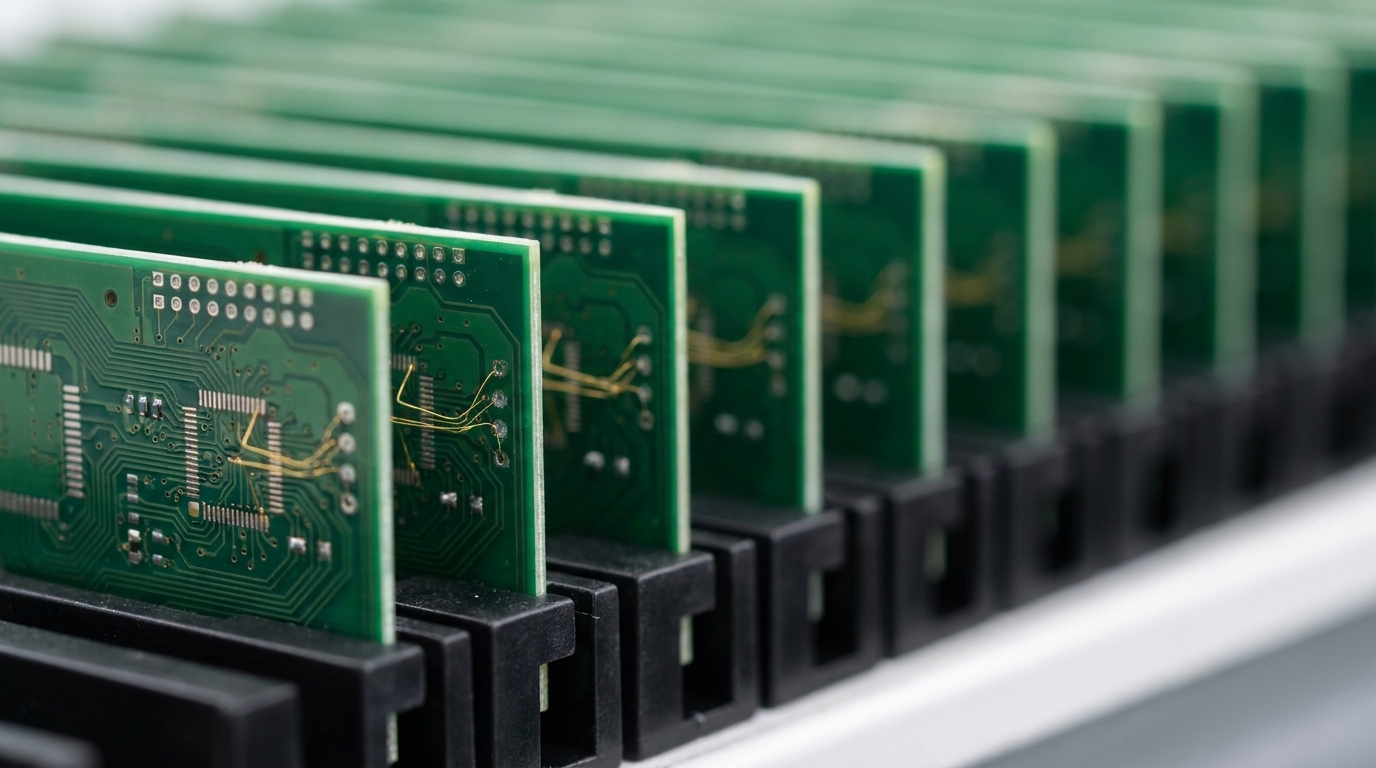
Key Takeaways on Gold Wire Bonding and Domestic Options
- Wire bonding creates reliable electrical connections between semiconductor chips and substrates using ultrafine gold wires through a thermosonic process with heat, pressure and ultrasonic energy.
- Gold ball wire bonding remains essential in 2026 for high-reliability aerospace, defense and medical applications due to proven stability and performance advantages over soldering.
- Gold wire delivers stronger corrosion resistance and long-term reliability than aluminum wire, which supports mission-critical microelectronics packaging.
- Typical configurations use 25 µm gold wire diameters with minimum reliable pitches of 150 µm, supported by pull and shear testing for bond integrity.
- Pro-Active Engineering delivers integrated domestic wire bonding solutions with ITAR compliance and full traceability, and supports high-reliability programs from prototype through production. Request a quote to review program requirements with our team.
How Thermosonic Wire Bonding Works in Practice
Thermosonic bonding combines moderate heating with ultrasonic vibration and bonding force to form consistent wire bonds for semiconductor packaging. The process starts with electronic flame-off that forms a free-air ball at the wire tip, then places that ball on the die pad under controlled force and ultrasonic energy.
This method delivers fast cycle times, strong bond integrity and repeatable performance across high-mix product lines. Manufacturers such as Nanosystems JP Inc. apply thermosonic gold ball wire bonding to form a gold ball on the die pad and a stitch bond on the package lead using coordinated ultrasonic energy, heat and pressure.
Quality verification ties directly into this process. Nanosystems JP Inc. uses wire pull and ball shear testing as standard inspection gates during gold wire bonding, which confirms bond strength before wafers advance in the assembly flow.
Wire Bonding’s Role in 2026 Packaging Strategies
Wire bonding maintains strong relevance in 2026 for high-mix, high-reliability applications across aerospace, defense and medical markets. Die bonders that support wire-bonded packaging, memory stacks and cost-focused consumer lines commanded a majority of 2025 die attach equipment revenue according to Mordor Intelligence.
This market position reflects wire bonding’s role as a workhorse technology where design flexibility and proven reliability outweigh density gains from newer approaches such as flip-chip. Flip-chip bonders continue to advance at a steady rate through 2031, but they expand the toolkit rather than displace wire bonding.
Growth in hybrid bonding and flip-chip equipment signals diversification of interconnect strategies. High-mix photonics and complex packaging lines in U.S. and European facilities benefit from this flexibility. Defense and aerospace programs continue to favor wire bonding because of its mature supply chain and long qualification history.
Soldering Compared With Wire Bonding Interconnects
Wire bonding and soldering rely on different connection mechanisms that affect performance and reliability. Soldering forms joints through molten metal alloy formation, while wire bonding creates solid-state metallic diffusion bonds under heat, pressure and ultrasonic energy.
Wire bonds remove the need for flux and support shorter electrical paths, which reduces parasitic inductance in high-frequency designs. This behavior improves signal integrity in RF, radar and high-speed digital systems.
Thermal performance also differs. Wire bonds tolerate higher operating temperatures and repeated thermal cycling without the fatigue issues that can affect solder joints. This resilience supports harsh aerospace and defense environments that experience vibration, shock and wide temperature swings.
Gold Ball Wire Bonding Steps and Quality Checkpoints
Gold ball wire bonding follows a defined sequence that focuses on repeatable reliability. The TPT HB100 wire bonder supports gold bump or stud formation using 25 µm gold wire on metallized pads with a ball-on-pad process. Electronic flame-off forms the free-air ball, which then bonds to the pad under controlled conditions.
Process parameters require tight control to maintain consistent bond quality. For 25 µm gold wire ball bonding on the TPT HB100, typical first-bond settings use ultrasonic power of 160 to 200, bond time of 80 to 200 milliseconds and bond force of 250 to 300 millinewtons. Second-bond settings adjust ultrasonic power to 200 to 250 with similar bond times and bond forces of 200 to 300 millinewtons to match the stitch connection’s mechanical needs.
Mechanical testing confirms that these parameters deliver robust bonds. Pull tests on 25 µm gold wire bonds using the TPT HB100 produced a mean peak pull force of 5.91 gram-force with a standard deviation of 1.54 gram-force across 50 samples. In that sample set, 78 percent met a 5.0 gram-force lower specification limit, which supports confidence before assemblies move to downstream processes.
Gold and Aluminum Wire Bonding for Long-Term Reliability
Gold wire serves as the most mature and stable wire bonding material for high-reliability IC packaging. It provides strong electrical conductivity, corrosion resistance, a wide process window and proven long-term reliability for mission-critical applications.
Aluminum wire offers lower material cost and supports high-current paths in power modules and automotive electronics. It is more sensitive to oxidation and surface conditions, and it can face fatigue or wire break issues under thermal cycling when process control falls short.
Gold wire remains the premium choice for high-reliability and fine-pitch wire bonding at Nanosystems JP Inc. It supports reliable bonding at pad pitches under 50 µm and maintains stable gold-to-gold interfaces over the operating lifetime. This stability supports decades of performance in aerospace, defense and medical systems.
Where Gold Wire Bonding Excels: Aerospace, Defense and Medical
Aerospace and defense programs such as radar, satellites and military electronics depend on high-quality bonding wires for mission-critical performance. Nanosystems JP Inc. applies gold ball wire bonding to RF chips, analog ICs, image sensors and devices that must maintain bond reliability in humid or harsh environments.
Medical devices such as pacemakers, hearing aids and implants also rely on semiconductor wire bonding accuracy. These products require stable interconnects that support long-term operation inside or near the body without performance drift or premature failure.
Request a quote to review application-specific requirements for aerospace, defense or medical programs and identify suitable wire bonding approaches.
Representative Gold Ball Wire Bonding Specifications
Gold ball wire bonding specifications shift with application needs and equipment capabilities. Tanaka’s GFC fine-pitch gold bonding wire with 15 µm diameter supports 35 µm ball pitch bonding on pads with 2 µm openings, as demonstrated on a Shikawa UTC-3000 bonder. Nanosystems JP Inc. offers gold wire diameters from 18 µm to 75 µm for ball bonding, which covers fine-pitch designs and higher current paths.
Wire diameter selection balances current capacity and pitch constraints. A 25 µm diameter gold wire configuration on the TPT HB100 supports fine interconnect formation, ball bonding and stud bumping for research, prototyping and small-scale microelectronics packaging. The minimum reliable pitch for 25 µm gold wire ball bonding on the TPT HB100 is 150 µm. At 100 µm pitch, the approximate 100 µm ball bond diameter can cause shorting between adjacent bonds.
Bond strength specifications guide process development and quality control. Tanaka GSA gold bonding wire achieves an average second-bond pull strength of 4.3 gram-force on QFN packages with PPF leadframes at 175 degrees Celsius. Tests show good stitch remaining after pull and a round squashed-ball geometry, which indicates sound mechanical performance.
When Traditional Wire Bonding Reaches Its Limits
Traditional wire bonding faces constraints in ultra-high-density and extreme miniaturization scenarios. On the TPT HB100, height variations greater than 100 µm between chip and substrate bonding pads can cause failures due to incorrect bond force or excessive tool impact from inaccurate Z-height referencing.
Loop height requirements also restrict package thickness in space-constrained designs such as compact sensors and implantable devices. These physical limits drive evaluation of alternative interconnect strategies for some advanced packages.
Flip-chip and hybrid approaches address several of these density and height challenges while adding their own complexity. Equipment suppliers now offer hybrid architectures that combine flip-chip, eutectic and pressure-sintering heads on a single chassis. This configuration allows contract manufacturers to support heterogeneous integration without frequent line changeovers, which benefits high-mix, low-volume production in North America and Europe.
Pro-Active Engineering: Domestic Wire Bonding and Hybrid Interconnect Support
Evolving interconnect requirements favor manufacturing partners that support both traditional wire bonding and emerging hybrid approaches. Pro-Active Engineering provides comprehensive wire bonding capabilities within an integrated domestic manufacturing workflow that addresses these needs.
Our Wisconsin facility combines wire bonding, flip chip assembly and hybrid high-density assemblies with PCB design, rapid prototyping and full system integration. This structure reduces vendor fragmentation and supports ITAR-compliant, fully traceable manufacturing for regulated industries.
ISO 9001:2015, AS9100, ITAR registration, JCP certification and Nadcap accreditation support secure, documented processes for aerospace and defense programs. NIST 800-171 alignment and CMMC readiness address cybersecurity expectations for sensitive projects.
Our integrated approach reduces program risk by embedding design for manufacturability from the earliest stages. The Speed Shop delivers production-ready prototypes using the same processes as full-scale builds, which simplifies the transition to volume manufacturing. Explore our domestic capabilities and request a quote to review program requirements with our engineering team.
Glossary of PCB and Interconnect Terms
Surface Mount Technology (SMT): Component mounting method that uses solder paste and reflow to attach components to PCB surface pads.
Through-hole assembly: Component mounting method that uses leads inserted through PCB holes and soldered on the opposite side.
Conformal coating: Protective polymer layer applied to PCB assemblies for environmental protection against moisture, dust and chemicals.
Design for manufacturability (DFM): Engineering approach that shapes product design for efficient, cost-effective manufacturing while maintaining performance requirements.
Ball grid array (BGA): IC package type that uses solder balls arranged in a grid pattern on the package bottom for high-density connections.
Next Steps for Selecting a Wire Bonding Provider
Wire bonding provider selection benefits from a structured evaluation of technical capabilities, quality systems and program support. Teams should first map requirements such as wire diameters, pitch limits, bond strength targets and environmental conditions. Certification needs such as ITAR compliance, AS9100 registration and traceability standards should be documented at the same time.
Provider assessments should extend beyond basic wire bonding services. Integrated workflows that combine design, prototyping and production reduce program risk and improve communication. Domestic manufacturing capacity plays a central role for defense and aerospace programs that prioritize supply chain security and reduced geopolitical exposure.
Request detailed capability demonstrations that include process parameters, quality checkpoints and certification documentation. This evaluation gains importance as the manufacturing landscape shifts. North America captured a majority of 2025 die attach equipment revenue, driven by CHIPS Act incentives, defense contracts that favor U.S. assembly and demand for premium hybrid bonders in advanced packaging and aerospace applications. This regional growth means domestic providers now offer strategic advantages for mission-critical programs that require long-term support and security.
Frequently Asked Questions
What wire diameters support gold ball bonding applications?
Gold wire bonding supports a wide range of diameters that align with application needs. Fine-pitch designs often use 15 to 18 µm diameter wire to meet tight spacing constraints, while many standard applications use 25 µm diameter wire. Larger diameters up to 75 µm support higher current requirements in power-focused designs. Each selection balances electrical performance, mechanical strength and pitch limits to support reliable operation.
How does gold wire bonding reliability compare with aluminum?
Gold wire bonding provides stronger reliability for mission-critical applications because of its corrosion resistance and stable intermetallic behavior. As discussed earlier, this stability reduces the oxidation and fatigue concerns that can affect aluminum wire performance. Aluminum wire offers cost benefits but requires tighter process control and faces higher risk of oxidation and thermal cycling failures.
What quality standards guide aerospace and defense wire bonding?
Aerospace and defense wire bonding follows strict quality standards such as MIL-STD-883 for process verification and testing. Quality verification includes pull tests, shear tests and visual inspections that confirm bond integrity. AS9100 certification demonstrates aerospace quality management compliance, while ITAR registration supports secure handling of defense-related technologies. Nadcap accreditation validates special process capabilities for critical applications that demand proven reliability.
Can wire bonding support high-density interconnect designs?
Modern wire bonding supports high-density applications with fine-pitch capabilities down to 35 µm ball pitch when paired with specialized equipment and tuned processes. Wire diameter and bond pad design set the minimum achievable pitch. Ultra-fine wire enables tighter spacing but can reduce current carrying capacity. For extreme density requirements, hybrid approaches that combine wire bonding with flip-chip or other advanced interconnect methods often provide the most effective solution.
What matters most for domestic wire bonding manufacturing?
Domestic wire bonding manufacturing offers strategic advantages that include ITAR compliance, reduced supply chain risk and improved program security. As outlined in the Pro-Active Engineering section, providers should demonstrate the full range of certifications required for defense and aerospace programs, including AS9100 compliance and ITAR registration. Integrated capabilities that combine design, prototyping and production reduce vendor fragmentation and support clear communication. NIST 800-171 alignment and CMMC readiness further address cybersecurity expectations for sensitive programs, while domestic locations support faster response times and closer collaboration.